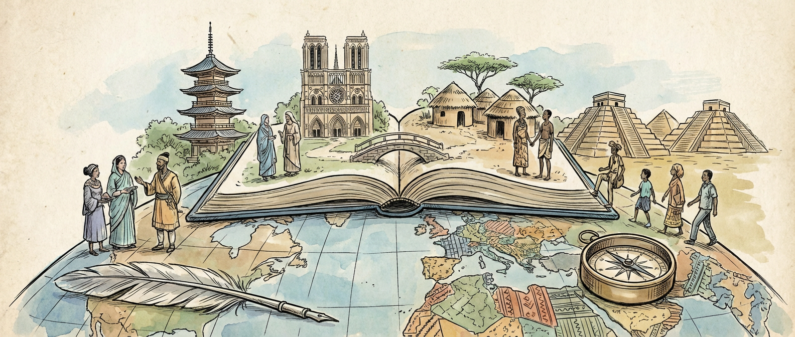
The Archaeology of Forgotten Literature
Every few months, a literary archaeologist emerges from university archives clutching a “lost masterpiece” that supposedly rivals Proust or Tolstoy. Publishers breathe life into these discoveries with elegant covers and breathless marketing copy. Critics genuflect appropriately. Then, within a year, these books vanish again into the same obscurity from which they came. This cycle reveals an uncomfortable truth: not every forgotten book deserves resurrection.
The “deserved obscurity test” asks a simple question: did this work fade because of historical accident, or because it simply wasn’t that good? Take Vicente Blasco Ibáñez’s The Four Horsemen of the Apocalypse. In 1918, it was the best-selling novel in America. Rudolph Valentino starred in the film adaptation. Today, most readers couldn’t identify a single line. This isn’t cultural amnesia. It’s literary evolution doing its work.
Things get trickier when we look at international literature, where language barriers, political upheavals, and cultural misunderstandings can bury actual treasures. Some books fail to travel not because they lack merit, but because they resist translation or depend heavily on cultural context. Others simply arrived at the wrong historical moment. Timing, it turns out, matters almost as much as talent.
When Politics Bury Quality
Political suppression creates the most heartbreaking cases of undeserved obscurity. Varlam Shalamov’s Kolyma Tales spent decades in samizdat circulation, known only to Soviet dissidents and a handful of Western scholars. When finally published in English, readers discovered prose that made Solzhenitsyn seem almost gentle by comparison. Shalamov had spent seventeen years in Stalin’s gulags, and his stories had a crystalline brutality that no protected writer could achieve.
Similarly, Pramoedya Ananta Toer’s This Earth of Mankind quartet remained banned in Indonesia for thirty years. Pramoedya wrote these novels without access to reference materials while imprisoned on Buru Island. He recited early drafts to fellow political prisoners before committing them to paper. The books eventually found international acclaim, but decades of suppression had already cost them their natural readership.
These cases show how outside forces can artificially create obscurity. The quality of the work stays constant, but historical circumstances prevent it from reaching readers. When political barriers finally fall, the best of these suppressed works tend to find their audience quickly. Their obscurity was imposed, not earned.
The Translation Trap
Translation creates its own challenges for the deserved obscurity test. Some works resist transfer between languages so completely that even excellent translations feel like echoes of the original. Others suffer from poor translation that completely misrepresents their quality.
Consider the strange case of Dezső Kosztolányi’s Anna Édes. Hungarian critics consider it one of the finest psychological novels of the twentieth century. Early English translations, however, flattened Kosztolányi’s subtle irony into heavy-handed social commentary. For decades, English readers encountered a work that seemed dated and obvious. When translator George Szirtes produced a new version in 1993, he revealed the novel’s true sophistication. The book hadn’t changed, but its presentation had.
This happens especially with experimental works that push language to its limits. How do you translate Arno Schmidt’s wordplay or José Lezama Lima’s baroque syntax? When translations fail to capture essential elements, readers may legitimately wonder whether the original deserves its reputation. Sometimes the answer is yes, the translation is inadequate. Sometimes the work truly is untranslatable and perhaps better left in its original language.
I think the most honest approach acknowledges that some books exist primarily for readers of specific languages. This isn’t cultural snobbery, it’s recognition that certain literary effects cannot survive translation, no matter how skilled the translator.
Cultural Context and Universal Themes
The strongest international literature transcends its cultural origins while remaining rooted in specific places and times. Chinua Achebe’s Things Fall Apart depicts Igbo society with anthropological precision, yet its themes of cultural collision resonate globally. The book’s enduring popularity proves that cultural specificity, rather than hindering universal appeal, can actually enhance it.
Compare this with novels that fail the deserved obscurity test by being either too universal or too particular. Generic stories about human nature, stripped of cultural detail, often feel bloodless. Meanwhile, works so embedded in local customs that they require extensive footnotes may struggle to engage foreign readers, regardless of their artistic merit.
The sweet spot lies in what translator Eliot Weinberger calls “the foreign familiar,” works that feel both exotic and recognizable. Naguib Mahfouz achieved this balance in his Cairo Trilogy, creating characters whose Islamic Egyptian context never obscures their fundamental humanity. Readers don’t need to understand the details of mid-twentieth-century Egyptian society to grasp Kamal’s intellectual struggles or Amina’s domestic concerns.
The Verdict of Time
Time remains the most reliable judge of literary value, though its judgments can take generations to settle. Books that survive multiple translation cycles, political changes, and shifting cultural fashions show genuine staying power. Those that require constant critical life support probably deserve their obscurity.
The test isn’t perfect. Great works can vanish because of historical accident, while mediocre ones persist through institutional momentum. But patterns emerge over time. Truly exceptional books tend to resurrect themselves, finding new readers across languages and cultures. They adapt to changing circumstances while retaining their essential power.
This doesn’t mean we should abandon literary archaeology entirely. The search for buried treasures remains worthwhile, if only to understand the full scope of human artistic achievement. But we should approach these excavations with healthy skepticism, recognizing that obscurity sometimes reflects honest critical judgment rather than historical injustice.
Have you encountered books that challenged your assumptions about deserved versus undeserved obscurity? What works do you think have been unfairly forgotten, and which highly praised “discoveries” left you wondering what the fuss was about?