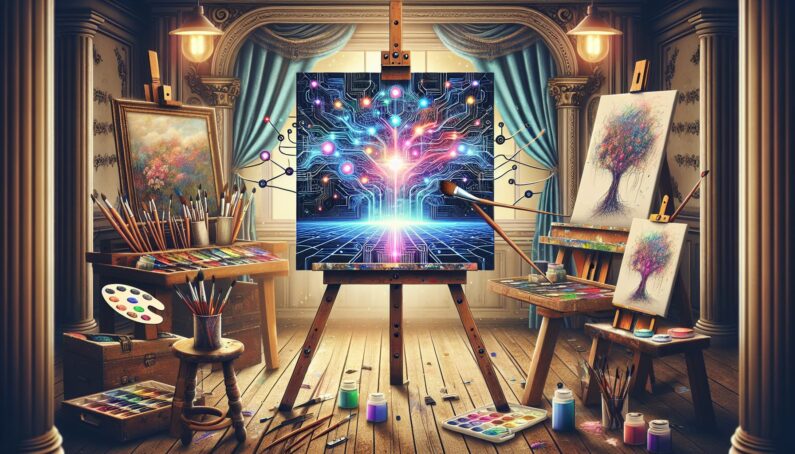
Why Artists and AI are Becoming Besties
Hey there, fellow tech enthusiasts! If you’d told me a decade ago that computers would one day help create art rather than just examples for math problems, I’d have labeled you mad. But here we are, with AI not just in our science labs, but in our painting studios, music rooms, and even on stage. We’re living in an age where creativity is getting its technological wings with a little help from Artificial Intelligence.
Picture this: AI isn’t just pushing the boundaries of technology. It’s dancing its way into the traditionally human-dominated space of creativity, and as a long-time tech nerd and art aficionado, I can’t help but be thrilled. The powerful algorithms and neural networks that once just crunched numbers and solved mundane problems are now drafting symphonies, designing mind-boggling art, and writing compelling poetry. Pretty neat, huh?
The Intersection where Code Meets Canvas
Let’s dig into how AI has gotten its brushes and musical notes tangled into one creative swirl. You might have heard of a little something called GANs, or Generative Adversarial Networks, which have a knack for generating novel images, sometimes better than a well-brewed espresso on a Monday morning. The OpenAI’s DALL-E is one such wizard. It can whip up a picture from just about anything you describe to it – an astronaut riding a horse in space? You got it!
Artists, digital creators, and even fashion designers are using AI to expand their palettes. Creativity is no longer a purely human domain, and frankly, that’s exciting! The fusion of human intuition with machine precision is leading to creations that are as refreshing as they are innovative. I attended an exhibition last month that featured AI-generated art. The depth and emotion in those pieces honestly had me questioning the existence of souls in silicon.
AI Bands and Algorithmic Symphonies
Now, let’s switch tracks to music. AI’s influence here is music to any geek’s ears (pun absolutely intended). With tools like Amper Music and Jukedeck, pretty much anyone can create music, regardless of their knowledge or expertise in the field. Imagine getting a personalized soundtrack for your life events created by a digital Beethoven! One particular instance I remember was when a friend, utterly tone-deaf, used an AI tool to compose a birthday song for her little brother. To everyone’s surprise, it was charming enough to become a family anthem.
Is this the demise of the musician as we know it? Not really. Rather, it’s allowing musicians to push their creative boundaries. Collaborations between AI and human musicians are becoming a mainstream component of this genre cross-pollination, opening new avenues for sound that weren’t possible before.
When AI Puts Pen to Paper
So, let’s talk words. AI has, in practice, picked up the pen and joined the literary party. Programs like OpenAI’s GPT-3 are producing prose and poems that are often indistinguishable from what a seasoned writer might pen. Whether it’s helping a struggling writer break through writer’s block or co-authoring a novel, AI is stepping firmly into the realm of storytelling.
I know it’s easy to imagine a future filled with AI-generated novels lining our bookshelves, but before we dive headfirst into a Black Mirror episode, we need to remember the importance of the distinctly human touch. AI in literature isn’t about replacing authors. It’s about expanding what’s possible. I tried using an AI writing tool to draft a scene for my short story collection. The machine’s quirky style brought a refreshing twist I never would have thought of.
Challenges and Ethical Tightropes
Nothing’s all sunshine and rainbows, right? There are genuine concerns about AI taking over the jobs of artists, musicians, and writers, leading to a real Terminator 2-style Skynet takeover – just kidding! But seriously, the fear of losing authenticity in the creative process is real. If a computer composes the symphonies of tomorrow, what happens to the heartbreak, the joy, the human experience that’s typically infused into art?
Then there’s the big ethical can of worms. Who owns AI-generated art? Can AI be credited as an ‘artist’? These are huge questions with implications for not just legal frameworks but for cultural definitions as well. As we forge ahead, it’s up to us and policymakers to ensure these tools are used responsibly and in ways that complement human artists rather than replace them. This technological turbulence could use some ethical guidelines, don’t you think?
Peeking into the Future
What lies ahead is uncharted and exciting from where we’re standing today. Imagine concerts where your next-door Alexa sings a duet with a hologram of Freddie Mercury, or virtual art galleries that change and adapt to your preferences. It sounds futuristic, almost sci-fi esque, but the way AI is stepping into the world of creativity, it’s only a matter of time before these concepts are as ordinary as a cat video on the internet.
In the end, the mingling of AI and the creative arts is more symbiotic than competitive. It’s about augmenting human creativity, not automating it. As an avid lover of both tech and art, I find myself in awe of this AI revolution. Who knew our silicon sinews would not only drive our data but also shape our dreams and imaginations? Here’s to the thrilling, slightly bewildering, but ultimately inspiring age of AI in the creative arts. Cheers to new muses and endless imagination!