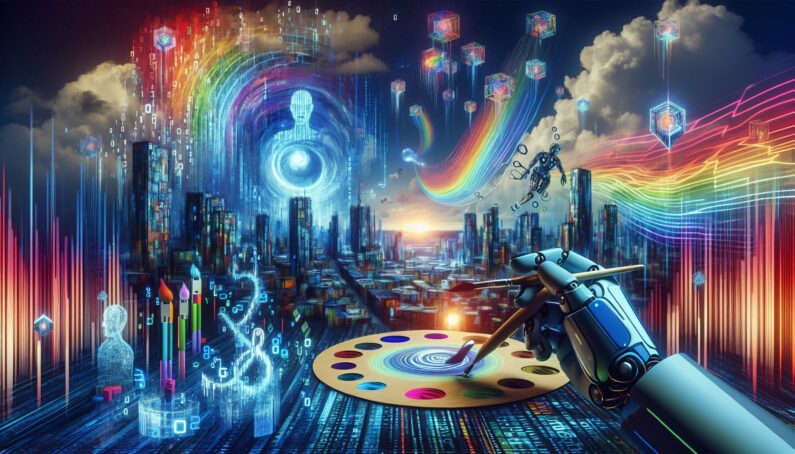
Hey there, fellow tech enthusiasts! Today, buckle up as we dive into an electrifying journey through the world of Artificial Intelligence and its weird foray into the arts. No, you didn’t misread—our silicon friends are not just calculating numbers and sorting emails anymore; they’re painting masterpieces, composing symphonies, and even crafting movie scripts. Let’s get into this emerging brainwave that’s got the creative industry scratching its head.
From Zeroes and Ones to Masterpieces
It wasn’t that long ago when the idea of a computer creating an artwork seemed like something straight out of a sci-fi novel. We’ve all seen movies where robots become sentient; well, we’re not quite there yet, but we’re inching closer. Thanks to advances in AI tech like neural networks, our computers are becoming surprisingly creative.
Remember when OpenAI’s GPT models started generating text that actually made sense? That’s the kind of leap we’re talking about. Tools like DALL-E and Midjourney can now create images from text prompts, each result weirdly impressive. An AI that knows the difference between cubism and pointillism? It sounds like the ultimate dinner party guest, doesn’t it?
The Rise of the Algorithmic Artist
So how do these AIs become so artistically talented? The secret sauce is machine learning. They’re trained on gazillions of images and datasets, which lets them understand styles, colors, and compositions. They might not have the keen eye of Van Gogh, but they sure can mimic it. And here’s the weird part: these aren’t just replicas. AI can combine elements in ways no human might think of, offering a fresh take on well-worn styles.
Imagine having an AI as your artistic intern. Adobe and its AI tool, Sensei, already help designers churn out creations faster by automating mundane tasks. You sketch a rough outline, and Sensei fills in the rest like magic. We have AI generating beats that sound like Mozart and Bach too. Pretty soon, AI might just be your favorite band member.
Reimagining the Creative Process
Seeing art from AI raises an existential question: What defines creativity? I mean, can a machine experience the sudden eureka moment we cherish as humans? Maybe not, unless its idea of transcendence involves binary code! Still, AI is challenging traditional views on creativity by encouraging collaborations between human artists and machines.
Musicians are blending AI-generated sounds with their instruments, creating “human-AI symphonies.” Writers are using AI for brainstorming and overcoming writer’s block. Even filmmakers are hopping on this tech bus, with AI-generated scripts and characters seeing the light of day.
And it’s not just established artists who benefit from this renaissance. AI makes art accessible to everyone. Anyone with a laptop can become an artist. Whether you’ve trained for years or never held a paintbrush, your potential is limited only by your imagination and whatever you can fit into a text prompt.
Ruffling Feathers in the Art World
Not everyone is embracing this with open arms. Critics fear AI will cheapen creativity or result in mass devaluation of art. I get it—it’s easy to picture rows of identical, soulless “masterpieces.” But consider this: AI isn’t here to replace artists; it’s here to expand possibilities and spark inspiration. It’s similar to when photography challenged traditional painters or when CGI stormed into the cinema. True art aficionados know that creativity keeps evolving regardless of its medium.
Plus, the conversation around intellectual property gets spicy. As AIs generate works based on works of other artists, there’s a legal gray area about who actually owns this new content. Is it the artist who provided the training data, or the company supplying the tech? Sprinkle that thought into your next dinner table debate!
The Future’s an Open Canvas
Look, I’m a techno-optimist with a touch of realism, believing that AI and creativity will walk hand in hand into the future. We’re just scratching the surface of what’s possible. Who’s to say AI won’t someday pioneer its own art styles completely divorced from human influence? Creepy and fascinating, right?
As technology keeps galloping forward, our understanding of what constitutes art and who can create it will change. But isn’t that how innovation always works? This revolution is an open-ended journey, filled with bizarre possibilities and unpredictable creativity.
So, let’s keep our eyes peeled and our canvases ready, because this is just the beginning of a colorful, AI-infused adventure. Keep dreaming big, keep experimenting, and if you’re feeling brave, maybe let an AI create something with you. Art isn’t about being perfect; it’s about pushing boundaries. Now, get out there and make some noise, human or otherwise!
Until next time, fellow tech adventurers. Stay curious!